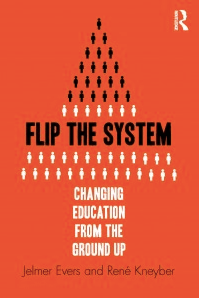
This is the copy of the book chapter I co-wrote with Prof Howard Stevenson of the University of Nottingham. The chapter, The Teachers’ Voice: Teacher Unions at the Heart of A New Democratic Professionalism, was written for a project called ‘Flip the System‘ – an initiative by two teachers from the Netherlands, Rene Kneyber and Jelmer Evers, to bring an alternative view from the ground to the debate on education reform. The book was published earlier this year.
Introduction
Teachers across the world are under pressure. It seems that everywhere the demands on teachers are increasing whilst at best the growth of resources fails to keep pace. In very many parts of the world, and especially following the global economic crisis, resources devoted to education are diminishing. The pressure is on to get ‘more for less’ from public education systems, and those who work in them.
Teachers experience these developments in myriad ways, but perhaps most sharply in the form of labour intensification – put simply, the relentless drive to work teachers harder and harder, sometimes until they simply burnout. Many school systems now operate on a high turnover-low cost model of teaching which cycles through an endless process of ‘bring in-burnout-replace’. However a parallel but arguably more significant development is the drive to assert ever greater control over the content of teachers’ work – what teachers do, how they do it and teachers’ ability to decide for themselves what is the most appropriate way to perform their job. Hence the trend to scrutinise teachers’ work forensically, and to convert key elements of the educational process to a number that can be easily measured, compared and ranked. Where this is happening teachers experience their work as being stripped of its pedagogical richness and complexity, to be a replaced by a process of management by numbers.
In this chapter we set out to show how teachers can reclaim their teaching. We do so by making the case for a new democratic professionalism based on the fundamental values of social justice and democracy and with teachers’ professional agency at its core. In the chapter we identify three domains of professional agency as areas of teachers’ work where it is vital that teachers are able to make and shape important decisions. However, our view is that teachers must understand their agency as both individual and collective and we argue that if teachers are to genuinely ‘flip the system’ then this can only be achieved if teachers organise collectively. Teacher unions therefore, as the independent and democratic organisations that represent teachers’ collective voice, are not only at the heart of a new democratic professionalism, but must be central to both making the case for it and mobilising teachers to achieve it. We conclude the chapter by setting out the steps that unions must themselves consider in order to mobilise teachers around a much more optimistic and hopeful vision of teaching.
Teacher professionalism and teachers’ voice
The concept of professionalism has always been problematic when applied to teachers as an occupational group. Traditional notions of professionalism were grounded in identifying the traits associated with ‘classic professions’, such as law and medicine. They emphasised a professional knowledge base and associated levels of expertise, professional autonomy, a commitment to public service and professional self-regulation. In most jurisdictions these are not characteristics that can be readily applied to teachers. There is little evidence of consensus about the role and status of pedagogical knowledge as it applies to the practices of teachers, whilst notions of professional autonomy have always been complex. Finally, professional self-regulation has seldom existed in the ways in which it is evident in many other professions. For these reasons, teaching has often been identified as a ‘semi-profession’ (Etzioni, 1969).
Given these debates some have suggested the concept of professionalism when applied to teachers is ‘beset with conceptual difficulties and ambiguities’ (McCulloch et al., 2000, p14) to the point that they question whether it has any meaningful intellectual value. Whilst we have sympathy with such an approach we also argue that notions of teacher professionalism cannot be ignored because conceptions of ‘professionalism’ cannot be disconnected from much wider questions about how society perceives teaching, and what it means to be a ‘good teacher’. Notions of the ‘good teacher’ are not fixed (Connell, 2009) and are in turn bound up with the on-going discourse and disputes about the nature and purposes of education. This approach was recognised by Ozga and Lawn (1981) when they argued that the concept of professionalism, and the struggles over its meaning, are best understood as a construct mobilised by competing groups in society to legitimate different, and oftentimes quite contradictory, approaches to teaching as work. Hence the state might refer to teacher professionalism in terms of responsibility and respect (the teacher as ‘model citizen’), whilst teachers might emphasise a professionalism based on expertise and pedagogical knowledge in order to make the case for greater autonomy.
This struggle over the meaning of professionalism is at the heart of many of the current debates about teaching and the role of teachers. Neoliberal education reformers have always been deeply sceptical of the concept of professionalism, seeing it as a device used by ‘producers’ to protect the vested interests of the ‘education establishment’ at the expense of ‘consumers’ (Demaine, 1993). This anti-professionalism is particularly critical of producer interest groups in education (such as teacher unions and educational researchers) because of the powerful ideological role that education performs in society. The ‘educational establishment’ not only protects its own vested interests, but it is also responsible for promoting a dangerous egalitarianism in schooling. Hence the argument that such producer interests must be curbed, in particular when organised in the form of unions, and that this is most effectively achieved by introducing the ‘discipline’ of market forces into public services. Many have argued that it is these pressures that have driven a form of ‘managerial professionalism’ (Whitty, 2008) whereby teachers’ professionalism is recast in terms of an ability to achieve specified performance targets in a competitive (quasi-) market environment (Stevenson et al., 2007).
For many years these ideas have been challenged by those who have made a case for a more optimistic and hopeful vision of professionalism and in this chapter we draw on three of these sources in particular. Firstly we are indebted to Judyth Sachs (2003) and her work relating to ‘The activist teaching profession’. Sachs’ book made a major contribution to thinking about teacher professionalism in new and more optimistic ways, but perhaps in particular it emphasised that professionalism must be both collective and active. Professionalism is more than passive membership of a club, but teachers must be active in creating and re-creating their collective professional identities. We also draw on Geoff Whitty’s (2008) case for ‘democratic professionalism’ in which he emphasises the need for teachers to work ‘beyond the profession’ in order to draw broader constituencies into the educational process. According to Whitty such a democratic professionalism
‘ . . . seeks to demystify professional work and forge alliances between teachers and excluded constituencies of students, parents and members of the wider community with a view to building a more democratic education system and ultimately a more open society.’ (p44)
Finally, in emphasising the importance of teacher agency in relation to a new democratic professionalism we very much draw on ideas presented by John Bangs and David Frost (2012) in their work for Education International.
Teachers’ voice and teacher unions
Ambiguities relating to the nature of teacher professionalism as a concept are also evident in relation to the role and purpose of teachers’ unions as the organisations that articulate teachers’ collective and professional voice. The use of the term ‘union’ clearly associates such organisations with the labour movement, and the notion of the teacher as a worker. This is an important statement of an objective position. The vast majority of teachers are employees, in an employment relationship in which their labour power (the ability to work) is traded in an exchange relationship with an employer (whether that is in the public or the private sector). Teaching is work and teacher unions therefore might rightly be expected to have a clear role in relation to defending and extending the pay and working conditions of their members. However, within the teaching profession, the role of teacher unions has always been much more complex with unions often claiming to be both labour union and professional association. Teacher unions therefore represent teachers’ collective voice across a very broad range of issues.
Our argument is that the ‘industrial vs professional’ debate within teacher unionism will always be an underlying tension that can never be completely resolved, but that to frame discourses about teacher unions solely in these terms is unhelpful and unproductive. The issues facing teachers, and the contexts in which teachers teach will always be determined by a mix of so-called professional, industrial and policy issues. For example, a policy to reduce class sizes has both a pedagogical dimension (professional) and a workload implication (industrial). Similarly, we believe it is not possible to challenge the spread of the managerialism that blights many teachers’ lives without having a wider political analysis of the global education reform movement (GERM) that has spawned it and drives it. Questions of politics and professionalism can never be artificially separated from more fundamental questions about the role of teacher unions in protecting basic pay and conditions.
Our view is these diverse issues need to be fused together to define a new vision of a democratic professionalism and that teacher unions have a central role in both articulating what this might look like, and crucially, mobilising teacher support to campaign for it. At one level teacher unions are at the heart of teacher professionalism because of their ability to represent the collective voice of teachers. However, teacher unions also represent the means by which a new democratic professionalism can be achieved. A new democratic professionalism will always need to be argued for, (re-)defined and fought for. Mobilising teachers around these aims will be a key challenge for teacher unions as they resist the spread of the GERM.
In the following section we develop our ideas about what a new democratic professionalism might look like and subsequent to this we set out the role of teachers’ unions in mobilising teachers in pursuit of these aims.
Re-asserting teachers’ voice: making the case for a new democratic professionalism
Underpinning our argument in this chapter, and the analysis in this book, is that there is currently a global struggle for the heart of education as a publicly provided democratic service. Inevitably this looks different around the world, but the threat has assumed the form of a global movement, and hence the response must be similarly global in form. Our conviction is that teachers must challenge the managerial view of professionalism that underscores the global education reform movement, and in its place articulate a much more optimistic vision of what education can look like, and what it means to be a teacher. Here we outline a framework that might underpin a new democratic professionalism, and in the final section we set out the organising strategies that teachers, working through their unions, will need to adopt in order make the prospect of a democratic professionalism a genuine possibility.
Our vision of a new democratic professionalism is based on three core principles:
- That teaching is a process of social transformation and that it should be underpinned, above all else, by values of social justice and democracy.
- That teaching is a technically complex process in which teachers need to draw on professional knowledge, pedagogical theory and personal experience in order to exercise professional judgement. Professional judgement requires agency by which teachers are able to make meaningful decisions based on assessments of context. The concept of teachers’ professional agency must be at the heart of a democratic professionalism.
- That teachers’ professional agency must be considered as both individual and collective. At times teachers will be able to assert their agency as individuals, quite appropriately. However, in order to secure meaningful influence in relation to the fundamental elements of teachers’ working lives then teachers will need to assert their influence collectively.
We are clear that any vision of a new democratic professionalism must be grounded in values that recognise the role and responsibility of public education, and hence the role and responsibilities of those who work as educators. Clearly there will be a wide range of views about what those values should be, and how these might be expressed. However, our view is that education is a public good and therefore the core values informing the service should reflect a commitment to social justice and democracy. If education is a citizenship entitlement then it must be underpinned by a commitment to equality. Similarly a commitment to democracy recognises the central role education plays creating an active, participatory citizenship. It also recognises that if schools have a role in preparing young people to be active citizens in a democracy, then schools themselves must be models of democratic practice.
In addition to this we argue that democratic professionalism is underpinned by a strong sense of teacher agency (Bangs and Frost, 2012) whereby teachers can exercise meaningful levels of control and influence in relation to three key areas of their work – we identify these as domains of professional agency.
The first domain of professional agency is in relation to teachers’ ability to shape learning and working conditions. Learning and working conditions can be considered to include all those factors that frame the environment within which teachers’ work, and in which students’ learn (Bascia and Rottmann, 2011). Such a list of factors is inevitably very broad. It would include issues such as the size of the class, the way classes are formed, the use of technology to support learning, the amount of preparation time a teacher receives and pay and reward determination. These are all aspects of teachers’ working lives in which a democratic professionalism would ensure that teachers were involved in meaningful decision-making. The precise form of this will inevitably vary but could include a range of possibilities from the freedom of teachers to make individual decisions in their own classroom through to national collective bargaining processes. The list of issues presented here also reinforces the unhelpful divisiveness that flows from distinguishing between so-called ‘industrial’ and ‘professional’ issues and instead recognises that all these factors have the ability to shape the learning experience.
The second domain of professional agency pertains to the development and enactment of policy. In this context we identify policy as the operational statements of values that frame the contexts in within which teachers’ work. Policy is often perceived as the preserve of upper case ‘P’ politicians, and ‘what governments do’. This is clearly a decisive factor in framing the contexts of teachers’ work, however, our notion of democratic professionalism sees teacher agency in relation to policy operating at many different levels with institutional policy making having a very significant impact on teachers and their work. Meaningful teacher agency in relation to the development and enactment of policy would ensure that teachers’ voices were heard not only in relation to national issues, such as the development of national curricula, but also, crucially, at school level also.
The third domain of professional agency we identify relates to teachers’ ability to develop their professional knowledge and professional learning, and teachers’ agency in this regard emphasises the ability of teachers to assert control over their own professional development. One feature of a managerial professionalism relates to the ways in which teachers’ professional knowledge has often been ignored as particular pedagogical practices have been imposed on teachers, whilst in other cases professional development has been used crudely to promote national initiatives or organisational objectives. These initiatives are often geared to meeting externally imposed targets, rather than being driven by the professional needs of the teacher. In a democratic professionalism teachers could expect to assert much more control over their own professional development, with correspondingly lower levels of imposition. In our view such professional development is likely to be both research-informed and research-engaged, with teachers actively involved in building the profession’s knowledge base.
We argue therefore that a democratic professionalism, based on fundamental values of social justice and democracy, emphasises teacher control and influence in relation to three domains of professional agency – shaping learning and teaching conditions, developing and enacting policy and enhancing pedagogical knowledge and professional learning. In making this case we also assert the need to consider agency as working at many different levels – from the individual classroom, through intermediate tiers (the school, local or regional government) to national government, and indeed to supra-national institutions. However, in order for agency to be exercised in these diverse environments it is vital that agency is understood as both individual and collective.
Many aspects of teacher agency that we have referred to should quite appropriately be a matter for individual teachers. A feature of any form of professionalism should be the scope for individual autonomy, and for those with high levels of skill and expertise to be able to exercise professional judgement without the need for micro-management from above. However, in relation to many of the issues raised in this chapter, agency cannot be exercised at the level of the individual alone. This may reasonably be applied to the level of government, where the capacity of individuals to make a difference is understandably limited. However, such an argument can be applied elsewhere in the system, when we recognise that there are many occasions when teachers must organise collectively if they are to be able to assert their influence. This is why teachers’ unions are at the heart of a democratic professionalism. Partly, and most obviously, because they promote collective agency by combining together and asserting the amplified voice of organised teachers. However teacher unions also have a central role to play in challenging managerialism more generally and thereby creating the spaces in which teachers can exercise their individual agency.
In this analysis teacher unions are central to the development of a new democratic professionalism. However if teacher unions are to be successful in setting this agenda they will need to work differently in order to draw a broader range of members into participation in the union. As such mobilising for a new democratic professionalism both requires union to renew themselves, but also offers the possibility of creating the conditions for renewal itself.
Renewing teacher unionism: organising for a new democratic professionalism
We have argued thus far that public education systems globally face a major threat, and that teacher unions represent a powerful bulwark against the attacks of the global education reform movement. However, teacher unions cannot afford to only be defensive in the face of this threat, but rather they need to assert a much more hopeful and optimistic vision of what it means to be a teacher. In this chapter we have sought to map out the broad features of what a new democratic professionalism might look like. Our argument is that this cannot be a vision that unions articulate for teachers, or on behalf of teachers – but that teachers must see themselves as integral to the union. This is the essence of collective agency and the notion of an activist professionalism (Sachs, 2003).
Our argument is that if teacher unions are to successfully articulate a new democratic professionalism then this must form part of a wider process of renewal in which the unions themselves develop as active, vibrant and engaging organisations. In summary, teacher unions as organisations must become models of the new democratic professionalism they seek to promote. In practical terms this involves the development of an organising culture in teacher unionism. We believe such an organising culture is predicated on three different elements:
Organising ideas – we have already argued that the ‘industrial vs professional’ debate within teacher unionism has been unhelpful. So-called industrial and professional issues cannot be readily separated, and the bifurcation serves to divide. Our view is that teacher unions must develop a much more holistic analysis of the teachers’ role, in which working conditions, professional issues and policy are all linked. This necessarily requires teacher unions to make explicit the political dimensions of policy that are often only implicit. The global education reform movement is a politically driven movement grounded in a globalised neoliberalism. A pedagogical issue such as assessment and testing cannot be separated from the wider questions of the purposes of assessment and testing. Who is driving the demand for more testing? For what purpose? Who gains as a result? These are ideological arguments and they need to be challenged ideologically. This is why teacher unions must not retreat from engaging in ‘professional’ issues, but they must also locate these issues in a much wider political context. Organising around ideas requires teacher unions to engage in the battle of ideas that must be won if the neoliberal dismantling of public education is to be successfully challenged. This is not a battle to be waged amongst the policy elites and disconnected intellectuals, but one in which teachers themselves need to be actively engaged as ‘organisers of ideas’ (Stevenson, 2008), or what Antonio Gramsci (1971) referred to as ‘organic intellectuals’.
Organising from the base – a common feature of labour unionism is a desire to centralise, as this is perceived as an effective means of securing equity. In many contexts, national collective bargaining has been seen as pivotal to securing national pay scales, and therefore a significant measure of pay equity. One consequence of this has been the centralisation of union structures as union organisation mimics the bargaining structures within which unions function. Such structures can have many merits, especially in contexts where national bargaining has been maintained. However, there is always a danger that over time the grassroots membership becomes disconnected and passive. Collective agency is asserted, but in a largely transactional manner. Members pay their subscription and then expect the union to represent them. Teachers are part of the union, but they do not expect, and often are not expected, to be active participants. The danger is that a dependency culture on local ‘hero leaders’ can develop and in the longer-term grassroots organisation atrophies. Organising from the bottom-up directly challenges this approach by ensuring that teachers recognise they are the union. This then requires the active development of the union at its base by engaging members in union activity. This may be quite traditional in form, such as organising around a local grievance, but our argument is that traditional notions of ‘activism’ are no longer sufficient and a much more inclusive approach to ‘activism’ needs to be considered. Participating in union organised professional development for example is an important way in which teachers experience and connect with their union, and through which, for example, the battle of ideas discussed above is advanced.
In summary, we believe that teacher unions need to focus attention on building the base in their organisations. Teachers need to experience their union as a key part of the their identity and ‘live’ the union whether it be through traditional workplace activity, union organised professional development or union sponsored social and cultural initiatives. None of this is easy – it can be costly in resources and requires a long-term perspective. It is however unavoidable if teacher unions are to build a strong organisation capable of halting, and then reversing, the forward march of neoliberalism in public education.
Organising for unity – the term union reminds us that the role of labour unions is to unite the disparate interests of individuals so the fractured power of isolated employees is combined and magnified through collective organisation. Unity is perhaps the most basic principle of trade unionism. It is however a principle that has not always been replicated within teacher trade unionism. For reasons too complicated to elaborate on here it is important to note that in many different jurisdictions teachers as an occupational group have failed to organise into a single union. As a consequence, so-called ‘multi-unionism’ in teaching is a common phenomenon. It can differ in form (different unions organising different groups of teachers for example) but in several instances it includes different unions competing directly against each other for the same teachers. It is difficult to see how this defiance of the basic principle of trade unionism can serve the bests interests of teachers. Our argument is that such divisions are now dangerously complacent in the face of an unprecedented attack on public education systems and the teachers who work in them. A key feature of the market-driven GERM is its intent to break-up and fragment, as a deliberate attempt to undermine the influence of professional interests within public education systems. Teacher unions cannot compound these divisions in the system by being further divided themselves. In order to facilitate renewal it will be important for unions to organise for greater co-operation, working together strategically and tactically but ideally moving towards union mergers.
However, organising for unity cannot be seen as being purely about working for union amalgamations, which always carries the attendant risk of being a largely bureaucratic process. An activist professionalism must also develop unity in much more organic ways within and beyond the teaching profession. For example, teachers as an occupational group, in very many different contexts, are becoming an increasingly diverse profession. Routes into teaching are becoming more diverse, and the teaching workforce can look correspondingly different. In many respects, although not in all, increasing diversity is to be welcomed. There are however dangers that an increasingly heterogenous profession becomes correspondingly more fragmented. The challenge for teacher unions, will be to seek to unify the profession, when very many tendencies push in contrary directions. Organising for unity will require teacher unions to find the common interests between teachers, in a world where employer interests will often be emphasising difference and division.
However, the search for unity cannot be confined to within the profession, but if it is to be successful as a movement for progressive change must extend beyond the profession. By this we mean that an activist democratic professionalism must involve an active engagement with students, parents and the wider community and that organising for unity must seek to develop common interests across diverse groups in the community (Whitty, 2008). We see the forming of such alliances as central to building a broad movement capable of challenging the GERM, and turning the tide against it. Once again, we do not underestimate the difficulties of doing this. Indeed research we have been involved in, has highlighted precisely how difficult this can be to achieve in practice (Stevenson and Gilliland, 2014). Teachers and parents are not always ‘natural allies’ and forging coalitions with community interests is complex and challenging. However, we see the development of popular alliances as not only central to developing the broad movement required for progressive change, but as fundamental to making any claim for democratic professionalism to indeed be genuinely democratic.
Conclusion
Teachers are not simply at the heart of public education – they are its heart. The centrality of teachers, and teacher quality in education systems, is now widely acknowledged (OECD, 2005). However, very different visions of teaching are emerging (Hargreaves and Fullan, 2012). One approach uses the language of teacher quality but at the same time seeks to drive down the costs of teaching and de-skill the work of teachers. It is based on a business model of education that seeks to maximise return on investment.
Teachers need to reclaim their teaching and assert a much more positive and optimistic vision of what teaching is, and what it means to be a teacher. It is not enough for teachers to be against managerialism and centralised imposition (although this can be an important springboard for activism). Teaching is intrinsically a hopeful endeavour and teachers need to be positive in their intent.
We believe this involves mobilising teachers, globally, around a much more positive vision of teaching. In this chapter we set out one element of that as a new democratic professionalism. It is not presented as a model or a blueprint, but rather it offers a framework to think about teaching and the role of teachers. It is necessarily flexible and needs to be the subject of much more discussion and debate.
A new democratic professionalism recognises the complexity of teaching and the sophisticated skills involved in the teaching process. Crucially it highlights the need for teachers to be able to assert their professional voice in relation to all the fundamental elements that frame their work – learning and teaching conditions, pedagogical knowledge and professional development and education policy broadly defined from institutional to national and supra-national level. We identify these elements as the three domains of teacher professional agency. However, in making the case for professional agency we are also arguing that this need to be located in a much deeper vision of a socially just and democratic approach to public education.
Such a vision of a new democratic professionalism goes against the grain of current policy in many parts of the world. It therefore requires teachers to challenge current orthodoxy and ‘flip the system’. Our argument is that this is simply not possible unless teachers recognise the need to act collectively, and organise accordingly. Individual teacher agency is important in a new democratic professionalism, but it is insufficient. Teachers must assert their agency collectively if they are to successfully turn the tide on the progressive tide of competition, marketization and privatisation.
This is why teachers’ unions are central to the new democratic professionalism because they are the means by which collective agency can be asserted. They are by no means the only possibility for collective agency, and nor should they be. However, they are the organisations that provide teachers with a voice that is collective, independent and democratic. These three elements alone make teacher unions fundamental to a new democratic professionalism. However teachers cannot rely on a type of transactional collectivism (‘what is the union doing about . . . ?’) but teachers must recognise that they are the union.
Teachers will not ‘flip the system’ unless, and until, they organise collectively. In this chapter we have attempted to trace out a vision of a new democratic professionalism that teachers can organise around. It is obviously incomplete and imperfect and we invite others to critique and develop the ideas presented here. As such our vision of a new democratic professionalism is not an end in itself – but a means to an end. The ultimate end, which will always be just beyond our reach, is a much more inspiring and transformatory experience of education for young people in public schools. If that is a vision worth fighting for then it is one for which teachers will need to organise collectively to achieve.
References:
Bangs, J. and Frost, D. (2012) Teacher self-efficacy, voice and leadership: towards a policy framework for Education International. Cambridge University/Education International http://download.ei-ie.org/Docs/WebDepot/teacher_self-efficacy_voice_leadership.pdf
Bascia, N., and Rottmann. C. (2011) What’s so important about teachers’ working conditions? The fatal flaw in North American educational reform, Journal of Education Policy 26 (6) 787–802.
Connell, R. (2009) ‘Good teachers on dangerous ground: towards a new view of teacher quality and professionalism’ Critical Studies in Education, 50 (3), 213-229.
Demaine, J. (1993) ‘The new right and the self-managing school’, in J. Smyth (ed) A socially critical view of the self-managing school, London: Falmer.
Etzioni, A. (1969) The semi-professions and their organization, New York, Free Press.
Gramsci, A. (1971) Selections from the Prison Notebooks, London: Lawrence and Wishart.
Hargreaves, A. & Fullan,M. (2012) Professional Capital: Transforming Teaching in Every School. London: Routledge.
McCulloch, G., Helsby, G., & Knight, P. (2000) The politics of professionalism: teachers and the curriculum. London: Continuum.
OECD (2005) Teachers matter: Attracting, developing and retaining effective teachers, Paris, OECD.
Ozga, J., & Lawn, M. (1981). Teachers, professionalism and class: A study of organized teachers. London: Falmer Press.
Sachs, J. (2003) The activist teaching profession. Buckingham: Open University Press.
Stevenson, H. (2008) Challenging the orthodoxy: union learning representatives as organic intellectuals in Journal of In-Service Education, 35 (4) 455-466.
Stevenson, H., Carter, B. and Passy, R. (2007) ‘New professionalism’, workforce remodelling and the restructuring of teachers’ work in International Journal of Leadership for Learning , volume 11 (15) available online at http://iejll.synergiesprairies.ca/iejll/index.php/iejll/issue/view/37 (accessed 1st October 2014).
Stevenson, H. and Gilliland, A. (2014) Natural allies? Understanding teacher-parent alliances as resistance to neoliberal school reform, paper presented at AERA Annual Meeting, Philadelphia, NJ April 3rd-7th.
Whitty, G. (2008) Changing modes of teacher professionalism: traditional, managerial, collaborative and democratic, in B. Cunningham (ed) Exploring professionalism, Bedford Way Papers, London: Institute of Education.












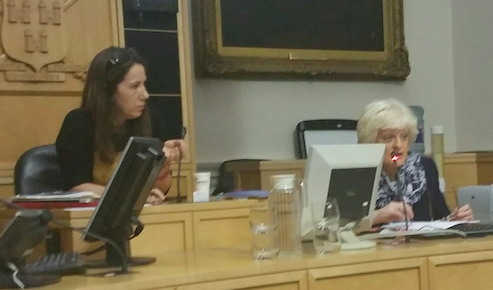





 Cllr. Alison Gilliland