Category Archives: Uncategorized

HOW we build houses is as important as what we build

Construction site, building a house - vector flat illustration.

Construction site, building a house – vector flat illustration.

Much talk has centred on housing standards recently and quite rightly – we need thousands of good quality homes right across Dublin, indeed in all of our urban centres. While there are many small developments in train there are 3 major parcels of Dublin City Council lands actively under development consideration. These lands – one in Cherry Orchard and two in Colic have the potential to provide over 1,300 homes. How these lands are developed is as important as the type of housing units we put on them.

We are all too familiar with the criticism heretofore that housing supply, particularly social housing, has been driven by private developers. Developers acquired land, contracted building companies to build on it and then sold the houses off for as high a price as possible – many of us bought into this and are living with the consequences, not only from a negative equity perspective but from the perspective of poor amenities – particularly green open spaces for our children to play on, high management fees and estates still waiting to be taken in charge by our local authorities. A small percentage of units were obliged to the local authorities – resulting in the disaster of the limited social housing supply we are not trying to grapple with and rectify.

Opportunity

This time around we have the opportunity to learn from the past and do things differently.  Developers are not the only option in town when it comes t building houses particularly on local authority owned land. Not-for-profit housing organisations take a different approach to housing development and return – a long term, here-to-stay approach. Not-for-profit housing organisations see the bigger picture – they don’t go in for a quick turn around but rather take a planned return on their investment through a mix of social housing rents, long-term secure private rental and sales to owner occupiers.

Not-for-profit

Working closely with not-for-profit housing organisations, local authorities can take advantage of their approach: housing types suitable for mixed-tenure housing needs can willingly be built; infrastructure and the key amenities needed to create and support long-term sustainable communities can be integrated into the overall plan and built as part of the process. Not-for-profit housing organisations also manage the developments once built – highlighting their long-term commitment to the community.

Market disruption/moral regulation

However, this approach is potentially disruptive. Long-term below-market rents and more appropriate profit margins on housing sales could impact on rising rents and house prices and introduce some moral regulation to the sector. This, could have a knock on impact on developers and landlords and their potential profit margins. Dublin renters and buyers, however, would be less concerned about affordability and possible homelessness.

Dare we move beyond the norm to date and demand an approach that will provide maximum housing return to our local authorities and to the citizens of Dublin?

If there is a will, there is a way!

1 Comment

Filed under Uncategorized

Standing in Solidarity with Dunnes Workers

DecencyDunnes_large

Dunnes Stores employees, organised by Mandate Trade Union, went on strike Thursday 2nd April. They are now organising a major demonstration on Saturday 6th June, assembling in Merrion Sq at 1pm. Their issue is decent work practices and pay:

  • Secure hours and incomes
  • Secure jobs
  • Fair pay
  • The right to be represented by their trade union

DunnesDemo_June6

Stand in Solidarity with Dunnes workers

It is key not only for the Dunnes workers but for the future of decent pay across the country now and into the future that we all stand in solidarity with the Dunnes workers. We need to send a signal that offering precarious work and zero hour contracts is NOT ok. We need to send a signal that workers are NOT cost units that can be used and abused in the pursuit of profit and competitiveness. We need to send a signal that workers are partners in employment, workers are talented and committed to carrying out their work and deserve fair recompense and security, workers have the right to be represented by their union and that workers are to be treated with respect.

DecencyforDunnes

Standing in solidarity means telling the Dunnes workers that what they are doing is right and that you support them. Standing in solidarity means marching with workers on Saturday 6th. Standing in solidarity means signing the Dunnes campaign petition. Standing in solidarity means wearing a ‘I support Dunnes Decency for Workers‘ sticker.  Standing in solidarity means following them on twitter @dunnesworkers and on FB Decency for Dunnes Workers Community. Standing in solidarity means reading up on the issues (see below and on www.dunnesworkers.com) and telling your friends to support the campaign.

Standing in solidarity is easy compared to fighting off employer intimidation and pressure, taking a very public stand by going on strike. Put yourself in their shoes – it takes courage and determination. Stand with them!

dunnes_button_petition

The Bigger Picture

While the Dunnes Workers strive to stand together and we will stand in solidarity with them we also need to look at the bigger decent work picture. Better legislation is needed to ensure that all workers are guaranteed decent work. The Low Pay Commission established by Minister Ged Nash and his investigation into the prevalence of zero hour contracts is an excellent starting point while the debate on a living wage is invaluable and sets a benchmark for the meaning of a decent day’s work for a decent day’s pay. However, we need binding legislation that ensures that decent work is the cornerstone of our jobs and economic development policy. Congress’ Legislation and Social Affairs Officer Esther Lynch, proposed the following 10 requirements in her address on Regulating for Decent Work to NUIM last year

  1. Require employers to provide the employee with a written statement of ‘normal working hours’ no later than the first day of employment;
  2. Increase the period of ‘compensated time’ so that employees are compensated for half of unworked time – currently employees are compensated for only a quarter of unworked time or 15 hours whichever is the lesser;
  3. Provide that ‘normal working hours’ can be calculated using the hours’ (i) stated in the employment contract /written statement or (ii) by using a reference period of 13 weeks and (iii) the hours the employee may be called into work, whichever is greater – this would also assist with addressing problems that have arisen when calculating holiday pay;
  4. Provide a right to request full-time work and a corresponding obligation on employers to seriously consider the request; allow refusals only where the employer can demonstrate the need for zero- hours type practices;
  5. Consideration should also be given to limiting the proportion of the workforce that can employed on zero-hour type practices; or
  6. Limit the length of time a post can be filled with workers on zero- hours type arrangements;
  7. Provide a right for employees to an overtime premium (e.g. time and a half) for hours worked in excess of the ‘normal hours’ in the employment contract/written statement;
  8. Provide that employees cannot be called into work for excessively short periods such as periods of less than four hours;
  9. Increase the notice period for rosters to at least a week – only in genuinely unforeseen circumstances should shorter notice of working time apply;
  10. Protect employees from penalisation for example, having their hours cut – “being zeroed down” when they stand up for their rights including organising in a trade union

These provide an excellent blueprint for a legislative approach that can secure decent work for all. We need to lobby our local representatives and our trade unions to progress the drawing up and passing of such legislation. Such legislation would negate the need for the Dunnes workers  or any worker to strike for secure hours, incomes and jobs.

A debate for another day that is linked to this bigger picture is whether or not the state in subsidising and indeed encouraging low flexible wages through tax cuts. Do employers not have a responsibility to contribute either wage increases or higher social wage (employer contribution) while the state has a responsibility to provide high quality public services? Another day ……

Cllr Gilliland call for new legislation: DunnesCampaign_PressStatement

The Key Issues

Secure hours and incomes

Many Dunnes Stores employees do not have regular guaranteed hours specified in their contracts. Many only have flexi-hour contracts (often a basic 15 hr contract) with no defined days or times. They tend to find out their working hours/days/times a few days in advance. As you can imagine, this means employees and their families find it difficult to plan or establish childcare or school drop-off and pick-up routines. It also means that employees do not know from week to week how much they will earn. This lack of income certainty has an impact on their ability to pay family bills, rents or mortgages.  It also has an impact on their social welfare support:

  • you have no entitlement to jobseekers payment if your 15 hrs are worked over 4 days or more;
  • you have no entitlement to Family Income Support if you work less than 19 hours;
  • you need to ear over €38 per week for a state pension stamp to be paid by the employer to the state
  • you must have a minimum of 520 paid stamps plus an average of 48 stamps, paid and/or credited, per year from the day they first start working in insurable employment to qualify for the full rate state pension contributory, €230.30 per week

Secure Jobs

While some Dunnes employees have permanent contract many other are on rolling contracts. This gives these employees no security for their future employment or career prospects. In a Mandate Trade Union survey of 1,200 Dunnes Stores workers 78% indicated that they were on part-time flexible contracts while 85%  indicated that insecurity of hours and rostering were used as a method to control workers – is this fair for one of the biggest employers in our state?

Fair Pay

Mandate Trade Union secured a 3% pay rise for Dunnes Stores workers in 2013. However, as indicated above many employees have flexible low pay hours that do not allow them earn a living wage. Workers want banded hour contracts that ensure guaranteed earnings (Bands: 15-19 hrs; 20-24hrs; 25 – 30hrs etc) and a further increase of 3%

The right to be represented by their trade union

Mandate Trade Union and Dunnes Stores management signed a collective agreement in 1996. However, Dunnes Stores have ignored this agreement and workers are frequently denied individual and collective representation. Is it not unreasonable to ask Dunnes Stores to implement the terms of the 1996 agreement with immediate effect and to recognise and respect the right of workers be represented by a trade union of their choice at both an individual and a collective level?

DUNNES STORES

Dunnes Stores is an iconic family owned retail brand and company. It was established in 1944 and has over 100 stores across the country with 10,000 employees, over half of which are organised. They have a significant share of the market – 23.8% (Kantar World Panel, Feb 2015) and have an estimated turn over of  €2.2bln and an estimate profit in grocery of €350m which when their clothing and household items are included could exceed  €500m. (Source Mandate Trade Union)

Further Reading and Info

Leave a comment

Filed under Uncategorized

Collective Bargaining Legislation

service engineer worker at industrial compressor refrigeration s

My colleague Cllr Brendan Carr gave an impassioned speech moving the motion to implement collective bargaining legislation before the summer recess this year.  I had the privilege of seconding it. Here is what I said

‘To me being a trade unionist and a Labour Party member are 2 sides of the same coin. We both view decent dignified work as the cornerstone of our society and what underpins a strong inclusive economy.

Each day across our country, sadly, workers are being exploited. Each day across our country the trade union movement strives to organise and support workers, to overcome their fear of speaking out and to face down employer prejudices.

A key impediment to their success is the lack of legislation recognising collective bargaining. This lack of legislation allows employers keep trade unions out and refuses workers the right to use their collective voice to have their say in what goes on in their working environment.

Take for example the constant and consistent work of Mandate Trade Union to organise and increase wage levels in the retail sector.  We are now witnessing the current battle they are waging with Dunnes Stores to ensure the continuation of collective bargaining.

The Labour Party is the party of decent dignified work and wages, the party of workers’ rights. No other party has our history nor our commitment to work and workers.

When workers look for support, they should automatically look to the trade union movement on the ground and the Labour Party in the ballot box.

While I absolutely commend the work the Labour party has done for workers. In particular, the work of Minister Ged Nash – since he took office workers are seeing a difference. However, we can wait no longer – we need to pass our legislation for the recognition of collective bargaining as soon as possible. We need to send out a tangible signal to every worker in the country that there is a better fairer way, a way away from the commodification of labour and towards decent dignified work and wages, a way through their collective voices and our political support’

Leave a comment

Filed under Uncategorized

Welfare entitlements for the self-employed

Hairstylist Washing Woman Hair. Hairdressing Beauty Salon

One of the issues that arose for me all too often while campaigning in last year’s local elections was the lack of unemployment supports for self-employed people when work dried up for them or disappeared altogether. At this weekend’s Labour Party Conference I proposed a motion that asked for changes be made to our welfare and PRSI system as per the recommendations of the Third Report of the Advisory Group on Tax and Social Welfare: Extending Social Insurance Coverage for the Self –Employed (May 2013).

This motion was passed and a first step in reversing this inequality and better support self-employed workers has been taken.

Below is the text of the motion and my speech

Too often during this recession and previous ones have we seen the impact on workers and their families when they lose their jobs. While not the same as a decent wage our social welfare system cushions their loss and helps provide for them and their families.

However, for those who are self-employed and find their work gone or drying up this is not entirely the case. Nor do they have the same supports when they have an accident or suffer an illness that leaves them unable to work. Think of your local taxman, hairdresser, electrician, beautician or plumber.This situation is unfair.

I wholehearted commend Labour’s success in government in retaining core welfare entitlements and creating progressive pathways to and opportunities for employment. I also commend the work Minister Nash is doing to improve worker’s rights.

However, our work for workers is incomplete – we must also act to afford self-employed workers protections and entitlements similar to those of their employed counterparts.

In particular, the means testing criteria and process for self-employed workers to qualify for Jobseeker’s Allowance needs to be simplified and aligned with the criteria of their employed counterparts. Entitlements to long-term illness, incapacity and invalidity benefits need to be extended to include self-employed persons.

Changes also need to be made to the welfare system to allow those previously self-employed workers or those under employed to access labour activation supports and training, particularly in cases where they do not qualify for Jobseeker’s Allowance.

Inherent in extending these entitlements is the need to change our PRSI system and the contributions made by self-employed workers to it.

In an environment where entrepreneurism and self-starting is encouraged and, indeed, viewed as a key strategy in employment creation it is essential that such workers are given assurances and protection when things go wrong. Self-employed workers are job creators of the future and deserve equal welfare protection.

In tandem with these changes to a fairer, more inclusive working environment, is the need to ensure full compliance with the Code of Practice for Determining Employment or Self-Employed Status of Individuals.

This is particularly necessary in sectors with high levels of flexible, precarious or casual workers or where intents are being made to exploit vulnerable and migrant workers and to circumvent labour legislation. I’m particularly thinking of the construction sector and recent issues highlighted by Unite Trade Union

All these changes are based on the evidence and the recommendations presented in the Third Report of the Advisory Group on Tax and Social Welfare: Extending Social Insurance Coverage for the Self –Employed (May 2013). I am therefore asking that we the Labour Party move to implement the recommendations of this report in Budget 2016 and that for a commitment to their full implementation in our Election Manifesto for the next General Election’

Original Text: Welfare Entitlements for Self-Employed Persons

Conference acknowledges that Labour’s success in government in retaining core welfare entitlements and creating not only progressive pathways to and opportunities for employment but also an environment that better protects and supports our workers. Conference, however, notes that despite making pay related social insurance contributions self-employed persons do not qualify for the same welfare entitlements as their employed counterparts. Therefore Conference calls for the full equalisation of welfare entitlements for self-employed persons in Budget 2016 and in the Labour Election Manifesto.

Leave a comment

Filed under Uncategorized

Worker pay, legislation and reform

Constructiion worker

2015 will be a key year for workers and their families

This year will see real benefits in workers’ wage packets while key legislation will enhance their rights and working conditions.

Key legislation and reform

Since his appointment last July, Minister Nash has been very pro-active in the area of workers’ rights and the initiatives announced and being progressed represent the delivery of Labour’s dignity of work agenda. Major reforms that will be realised in 2015 include:

  • Legislation for an improved framework for workers who seek to better their terms and conditions where collective bargaining is not recognised by their employer. It is anticipated that the draft legislation will become law by mid-2015;
  • The Low Pay Commission set up early this year by Minister Ged Nash, will report to the Government on the appropriate rate for the minimum wage
  • An inquiry, also established by Minister Ged Nash, will report to the Government on the prevalence of zero hour and low hour contracts and the impact of such contracts on employees;
  • The proposed Workplace Relations Bill, currently at Report stage will, when enacted, replace the current five workplace relations bodies with two. The new system will provide a world-class service for employers and employees, while also delivering savings for the taxpayer. The new workplace relations system will comprise two bodies – the Workplace Relations Commission which will deal with complaints at first instance, and the Labour Court which will deal with appeals;
  • 200,000 SMEs and 12,000 start-ups every year will be able to substantially reduce the costs and time associated with establishing and running a company, as a result of a range of reforms to be introduced as part of the landmark Companies Bill. The Bill, which has passed all stages in the Houses of the Oireachtas and has been sent to the President.

The impact of Budget 2015

Workers will also begin to see the impact of Budget 2015 in their take home pay at the end of this month, particularly low and middle-income earners. We will see the impact of

  • an increase in the USC entry point to €12,012, removing a further 80,000 low paid workers from paying USC
  • a cut in lower rates of USC from 2% to 1.5% and from 4% to 3.5%
  • a widening of the standard rate band of income tax by €1,000 to €33,800, taking 33,000 people out of the top rate
  • a cut of 1% in the top rate of tax for workers earning from €33,800 up to €70,000

Progress on Jobs in 2014

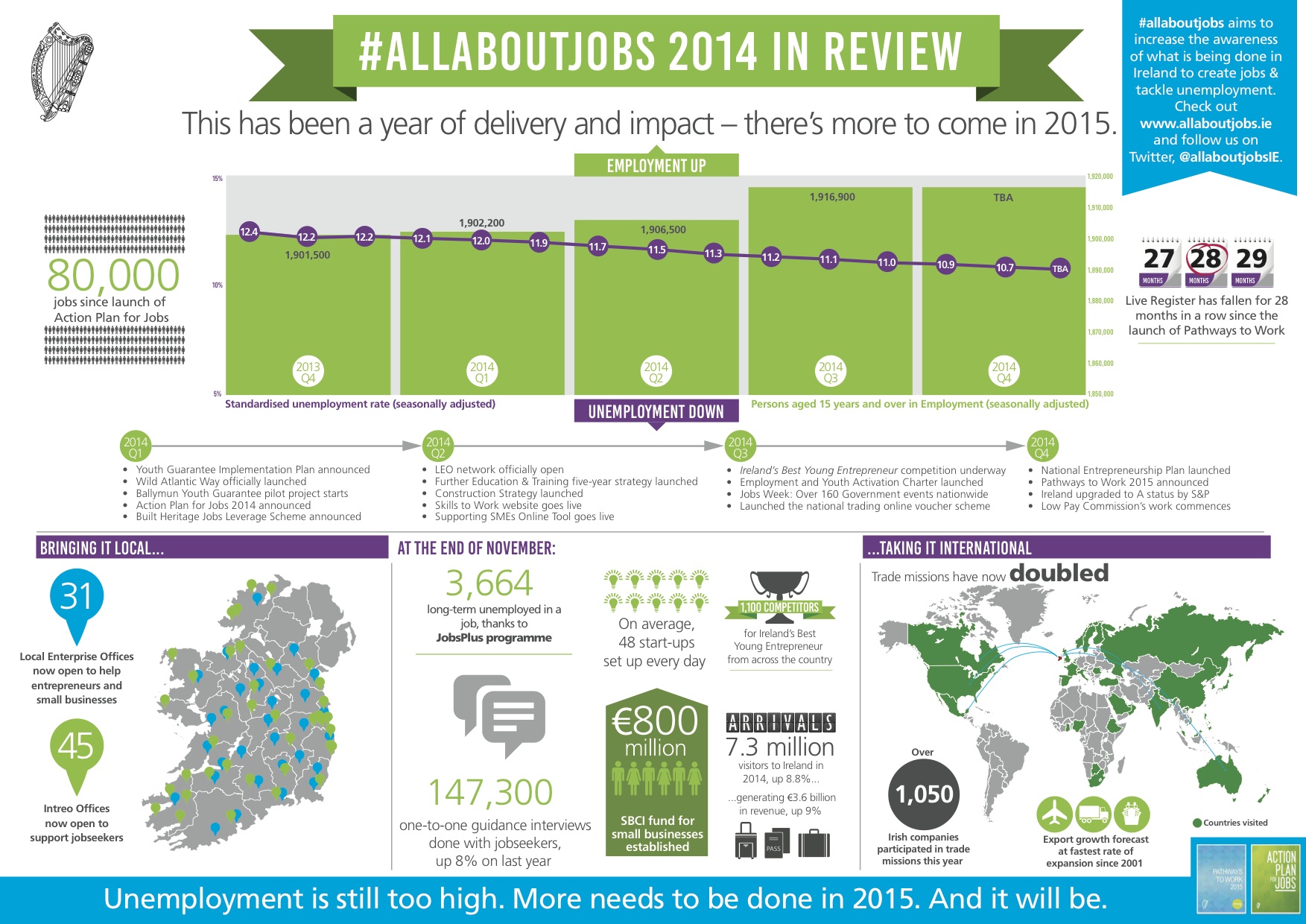
 Allaboutjobs_yearinreview_infographic

There are now 27,600 extra people at work than a year ago, with 80,000 additional people at work since the realisation of annual Action Plan for Jobs.  The infographic above highlights this progress – click HERE for greater detail while the info graphic below summarises the main achievements. This progress will continue into 2015.

Recovery_Jan15

Leave a comment

Filed under Uncategorized

New Water Plan

IrishWater_Mark_Colour_2

Labour’s Alan Kelly TD has taken the previous Irish Water plans drawn up by Phil Hogan TD by the scruff of the neck and listened to the concerns expressed by the people with regard to the cost and affordability of water, the potential for privatisation of water and the complex charging system. He has completely reworked the plan and introduced a fairer, more certain and simpler plan.  In summary:

  • Charges are being capped: €160 for a single adult household (with or without children) and €260 for all other households
  • A Water Conversation Grant of 100 euro per household thus reducing the capped rate to €60 for a single adult household and €160 for all other households
  • These charges are fixed until the end of 2018
  • No PPS numbers will be needed in relation to payment or water conversation grant application
  • First bills will issue from April 2015
  • Water metering will continue to monitor water consumption and support water leakage detection.
  • A variety of payment options are available including a minimum 5 euro payment off bills, paid at the householders convenience
  • Water pressure will not be reduced in incidences where householders do not pay their water charges, however, penalties will be applied to the household.
  • A first free fix will apply to any leaking pipes within a household’s boundary.
  • Irish Water is a publicly owned utility. It can only be privatised by the will of the people though a special referendum
  • A new board will be put in place, members of which will be appointed through a public appointment process.

The new plan takes account of concerns relating to affordability, of concerns regarding future payments and charges and concerns regarding the privatisation of Irish Water. The new plan is simple, certain and ensures Irish Water will remain in public ownership unless the people wish to privatise it.

Labour has listened, Labour has delivered!

Leave a comment

Filed under Uncategorized

Have your say

CityDevPlan

The City Council is commencing the process of preparing the new Dublin City Development Plan. This plan will detail how our city looks, feels and provides  services and amenities for its citizens. It will also determine safe green sustainable strategies for Dublin as a city to live and work in.

This plan will be completed within the next 2 years. To inform the process, the City council has developed an Issues Paper which is available to view in all public libraries and Area Offices. It details the following issues for consideration by Dubliners who live and work in the Dublin City area:

  • Shaping the City
  • Climate Change Adaptation and Mitigation
  • City and Regional Economy
  • Movement and Transport
  • Population and Housing
  • Sustainable Environment and Infrastructure
  • Green Infrastructure, Landscape, Open Space & Recreation
  • Retailing
  • Culture and heritage
  • Community Infrastructure & Social Inclusion
  • Environment

Once developed all planning applications will have to adhere to the direction of the plan.

Have your say

You as a Dublin citizen can have your say in this plan. The Issues Paper is available to view in all public libraries and in local area offices. You can make your views known using an online submission facility at  www.dublincitydevelopmentplan.ie or drop by to one of the pop up information stands in your local council offices. Deadline date for submissions is 14th January 2015.

North Central Information Session

The North Central information is taking place on Friday 28th November from 7.30 – 8.30pm in the North Central Civic Centre, Bunratty Rd.

Leave a comment

Filed under Uncategorized

Working Together Works

Great news for Belmayne residents!

This afternoon I presented a motion to the North Central Area Committee meeting to make available to local residents the DCC owned land in front of the Belmayne estate. The motion was unanimously passed.

BelmayneLand

Green area show land that will now be opened to Belmayne Residents

While this land forms part of DCC’s strategic land bank, there are no plans to develop it in the near future. It is regularly maintained, fenced off and secure and is a ready made playing field for local children and young people.

Belmayne is an unfinished estate with only one small playing area for younger children but nothing for older children and teens. Local residents have been crying out for facilities within the estate, somewhere nearby where children and young teens can kick a ball around and still be within view of home.

Dublin City Council is waiting on the estate developer who is in NAMA to finish off the estate before it can take it in charge – this situation has been dragging on for several years and is causing huge frustration amongst residents. Making this small piece of land available positively supports Belmayne parents and young people’.

Motion Successful

The motion was unanimously passed at this afternoon’s North Central Area meeting.

This success shows the positive outcome of local Residents’ Associations and a public representative working together to resolve local issues. I would like to commend its chairperson, Michelle McGoldrick, in pushing to get this amenity for her community. Thanks to her & other local residents this local recreational need has been achieved!

Motion

That Dublin City Council make available and open temporarily to the residents of Belmayne the DCC owned land in front of Belmayne Estate bordered by the Malahide Rd. This area of land is flat, it is well fenced off and secure and is maintained by the Housing Department of the DCC. While the area forms part of DCC strategic landbank for future housing development no such plans for development are in place. The residents of Belmayne are currently suffering form the impact of an unfinished estate with very few green areas for children and older teens to play in. This well-maintained area would provide a ready-made secure green space for such recreational activity adjacent to the estate and within a view of many parents living in the estate until such time development begins on the land.

Interview on issue

Thanks to our local community radio Near Fm for picking up and highlighting this issue. Here’s the podcast of the interview they did with me 


Leave a comment

Filed under Uncategorized

Local Property Tax Vote

bigstockphoto_Breach_Of_Prison_534636

Tonight the majority of Dublin City Councillors voted to reduce the local property tax to be paid by households in the Dublin City are by 15%.  I did not support this reduction, neither did my Labour colleagues. We proposed a more balanced 7.5% reduction.  Here’s why:

Dublin City Budget

Each year the Dublin City Council has to agree a budget which must take into consideration the amount of money available to it to spend. Neither the total amount of money available to the Council nor the extent of services required is known at present. However, what is known is that we have a severe homelessness crisis (Dublin City Council provides financial support towards homeless services), that our local street cleaning and maintenance services are now provided on a less frequent basis and less money available to build and enhance local playgrounds and recreational amenities. In addition to this Dublin City Council staff numbers have been reduced in an effort to reduce costs. The knock on effect of this is that it takes longer for staff to get things done because they are doing more with less human resources. Therefore, in a case where not all the variables are known and services have already been curtailed, I believe it is best exercise a measure of caution unlike previous occasions (remember the night of the bank guarantee???).

Giving something back

It is in the gift of Dublin City Councillors to reduce or increase the local property tax by up to 15%. Your property tax is calculated against the value of your house, therefore, the more your house is valued the more property tax you pay. For example:

  • if your house is valued between €100,000 and €150,000 your local property tax is set at €225
  • if your house is valued at between €200,000 and €250,000 your local property tax is set at €405
  • if your house is valued at between €300,000 and €350,000 your local property tax is set at €585
  • if your house is valued at between €400,000 and €450,000 your local property tax is set at €765
  • if your house is valued at between €500,000 and €550,000 your local property tax is set at €945

Therefore, a 15% reduction would return most to those who pay most. Given that there is a strong correlation between the value of someone’s house and their ability to pay (with the exception of those who previously were high earners but have lost their jobs) those who have higher incomes benefit most from a higher property tax reduction:

  • A 15% reduction to those who pay €225 will return a total of €33.75 or 65 cent per week.
  • A 7.5% reduction to those who pay €225 will return a total of €16.88 or 32 cent per week.
  • A 15% reduction to those who pay €945 will return a total of €141.75 or €2.73 per week.
  • A 7.5% reduction to those who pay €945 will return a total of €70.88 or €1.36 cent per week.

Fairness and equity

I would much prefer had the legislation governing local property tax allowed for a flat rate increase or decrease. This would be fairer. Returning €100 to each household would benefit those on the lowest incomes.

While I agree that the lowest earners in our community find paying bills the hardest, I believe that when it comes to providing local, and indeed public, services we get more benefit from pooling our money collectively. This is why myself and my Labour colleagues rejected the full 15% reduction or just over €12m  and proposed a 7.5% reduction. This would retain  just over €6m and return just over €6m to households. To put this amount in perspective, the Dublin region is facing at least a €6m homeless budget shortfall in 2014 due to the rising numbers of people needing Emergency Accommodation. Or, alternatively, this €6m would just about pay for a street cleansing package of 10 additional litter wardens, one annual city wide junk collection and an increase in street sweeping from once every 3 months to once every month.

Our proposal, had it been successful, would have given a small amount back to each household but would have better protected local services, particular to those who are most vulnerable.

Vote

The debate on the various proposals was cut short tonight and one composite motion proposing a reduction of 15% was proposed and agreed by the majority of councillors in the Chamber. I had sought to speak but was not given the opportunity. Had I had the opportunity this is what I would have said:

Tonight my colleagues and I in Labour could have chosen to play the populist political game, passing the buck of providing adequate funding to this council on to central government and proposed a 15% reduction in our local property tax. However, instead we chose to take a balanced responsible lead, proposing a mid-way reduction of 7.5%, a return equivalent to just over €6m to Dublin City Council area households. 

We have all been elected to make decisions on behalf of the people of the City of Dublin, to take responsibility and not to pass that responsibility on, and indeed pass on the blame when it’s convenient, to others who may or may not provide.  I take that responsibility very seriously. This is why I support better protecting our local services rather than returning the maximum advantage to the most affluent. 

I don’t disagree that those on lower incomes need particular support, however, we must bear in mind our responsibility to protect local services as best we can. How often have we heard that our streets cannot be cleaned more frequently or the grass on our community pitches cut more frequently due to insufficient funds? How often have we heard that new play grounds and recreational amenities cannot be built due to insufficient funds? Cutting a full €12m out of our Dublin City Council budget will continue with this situation. 

Aside from reduced local services and an inability to adequately support homeless persons, a further concern I have is the potential impact these cuts will have on our local authority jobs. Such a significant cut promotes outsourcing in an attempt to make efficiencies when local authorities struggle to balance books on a reduced income. Those who advocate for workers’ rights and decent should bear this in mind in our debate here this evening. 

Therefore, I urge you colleagues to take a more responsible and balanced approach, an approach that provides some alleviation to each household AND better protects our local services. 



Leave a comment

Filed under Uncategorized

Renting and Worried about Losing your Home? 

Renting

We all know there is an housing crisis and while steps are being taken to ameliorate the situation many people are living in fear that they will become homeless at the whim of their landlord. Both tenants and landlords have rights and responsibilities. Landlords cannot ask tenants to leave on a whim. If you are in a situation whereby you fear this please free phone 1800 454 454 and avail of the new local authority/Threshold support service. This service with assess your needs and take initial steps within 24 hrs. For more see

The service will also support you if you have a dispute with your landlord. If you are in receipt of Rent Supplement from the Department of Social Welfare the service may enable you to be provided with additional support (allowance) for an emergency period.

Please share

Please share the following information as widely as possible. Many tenants are not aware of their rights and many landlords may seek to surreptitiously end a tenancy agreement so as to avail of increasing rents due to increasing demand. This results in many tenants unnecessarily losing their home.

Prevention Leaflets

If you are a community organisation in my local area and would like some of the prevention leaflets to distribute please contact me and I’ll send them out to you.

Leave a comment

Filed under Uncategorized